Showing posts with label cemeteries. Show all posts

Wednesday, August 31, 2016

grave post - Dionne and Fraser

On the south shore of the St Lawrence River, about 400 km northeast of Montreal is the small town of Kamouraska where you can find this small memorial park. 
Since 1994,  300 years after the first settlers arrived, it has been recognized as a heritage site.
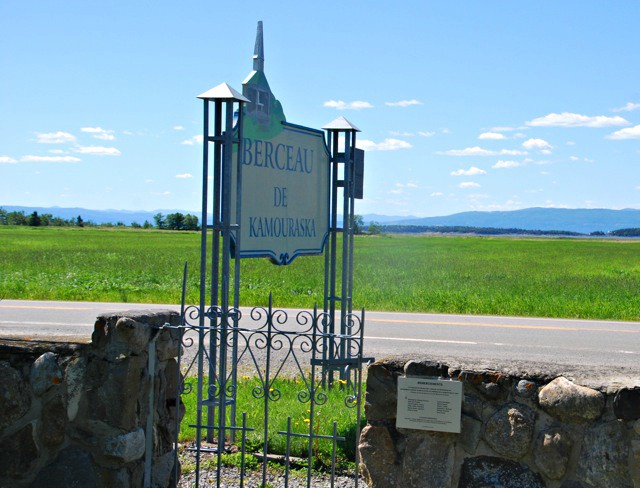
Berceau translates as cradle in English and there is a rest area, a cemetery, and a memorial chapel

I was pleasantly surprised to find this slightly askew explanatory plaque in English
There is a monument dedicated to the early settlers with the names of 220 families. This seems extraordinary as there are less than 600 people living there now. I don't quite know how this works, but from the individual family gravestones many seem to have a 'family association' who have researched their genealogy and erected markers in homage to their ancestors.
Canada is a very young country and it almost felt like an honour to see a marker erected for a family who arrived here in 1698

My family is quite small. I never knew my grandparents and the rest of my mother's family (which consisted of one sister and three cousins) are scattered around Scotland and England. The Dionnes of Kamouraska had numerous descendants of the first three generations who lived here. I cannot imagine what that must be like. 
Grand-père Antoine and Grand-mère Catherine were married at ages 19 and 16, likely in France in 1660. They would have 12 children of which Jean would be their third born. Jean and his wife Marie-Charlotte would have eight children, with Jean-Baptiste being the second born. Jean-Baptiste and his wife, Marie-Madeleine would have nine children. Of all those 29 children, seven would die in infancy. There were too many cousins to continue counting.
It seems to have been a common part of life at the time to have a series of haphazardly spelled names, (as I discovered when researching another grave post from this cemetery for Kerouac) and here, John Fraser, born in Inverness, Scotland, also went by the names Jean Le Gros and Jean-Baptiste Grosjean and even Jean Phraser and Jean Fraiser. However he or his descendants (or the clerks who wrote it down) chose to spell it, John arrived here as a member of the 78th Fraser Highlanders during the Seven Years War. When they were disbanded in 1763 many of the soldiers chose to stay in Quebec. Jean/John would marry Marie-Josephe – aka Marie-Josette – Dumont on February 10th, 1777 when he was 47 years of age and Josette was 24 years of age. Things are a little murky on the genealogy site, but it seems there were two children born in 1777 – an Anastasie and a Jean-Baptiste (twins?). But, there's also listed a Pierre Fraser born 1772 (when Josette would have been 16) and a Jean-Michel Dumont whose father may or may not have been our John/Jean Fraser born 1771. Another daughter, Marie-Theotiste would be born in October of 1780, a mere two months before John/Jean died.

Monday, November 17, 2014

city of the dead

Yes, I did go visit a cemetery while I was on holiday in Scotland in August. and in a perfect case of serendipity, a guided tour was happening the day I arrived. it was free, but you needed to register and my cousin and her husband and I managed to reserve spaces. it wasn't a very big group, not even the limit of 25 people (the guided walks in our cemeteries tend to be extremely popular with dozens of people, but maybe it being a Bank Holiday weekend had something to do with it) and by the end of the over 3 hour (!!) walk, only four us were still with the group leaders - yes, us three plus one other hardy soul! but we all found it well worth the time. 
after crossing the Bridge of Sighs, we did have to climb up a rather steeply terraced hill... and back down again


The Adjoining Bridge 
was erected by 
The Merchants House of Glasgow
to afford a proper entrance to their new cemetery continuing
convenient access to the grounds with suitable decoration to the 
venerable cathedral & surrounding scenery to unite the tombs of many generations
who have gone before with the resting places destined for generations yet
unborn where the ahes of all shall repose until the resurrection of the just when that  which
is born a natural body shall be raised a spiritual body when this corruptible must put
on incorruption when this mortal must put on immortality when death is swallowed up in victory.

Unfortunately, the walk started at about 6pm and by then, the sun was intensely determined to create long shadows, making it difficult to get good photos. plus, because these were all unfamiliar names to me, I wanted to pay attention and not wander off as I usually am wont to do. so, fewer photos than I usually take.
The cemetery opened in 1833 as the first interdenominational garden cemetery in the city. though, the year before, a small Jewish burial ground was established in the north west corner (it would be declared 'full' by 1851 - it is very small) It is now a closed cemetery - no more burials are allowed. There are over 50,000 people resting here, but only about 3,500 monuments have been put up. 


climb up the walkways and you get the bonus of great panoramic views over the city. here, we are looking out towards the Cathedral and Royal Infirmary
this is to the south                and east


considering all the space, these souls are rather tightly packed in
eventually we get to the highest point where the statue of John Knox has stood on this high column since before the cemetery was built
and then we descend back towards the cathedral square 
and through the gates to the land of the living


sharing this walk with Monday Walks at Restless Jo

Tuesday, November 4, 2014

grave post - Moor/Hughes

in memory of
Thomas Moor Jr 
killed in action at Batoche NWT May 9th 1885
Isaac Hughes 
died at Battleford NWT September 1st 
from injuries received in action at Batoche May 12th 1885

Private Moor was only 18 years old and Private Hughes was 20 when they died. They were part of the Tenth Royal Grenadiers who fought at the Northwest Rebellion.


I didn't actually notice the inscription on the base - this was taken during the tree walk and I didn't want to get too distracted, but the carving just needed a photo. After I uploaded it, I found the names. According to Mike Filey's Guide to Mount Pleasant Cemetery, there is also an almost obliterated inscription on the west side that reads:

The Officers, non-commisioned Officers and men of the Royal Grenadiers, congregation of Elm Street Methodist Church, the teachers and pupils of Ryerson School and a few citizens have united in erecting this stone to the memory of those whose names are hereon recorded as having lost their lives in the service of their country.

Batoche was a settlement on the South Saskatchewan River that was the headquarters of Metis leader Louis Riel. The siege lasted three days before Riel surrendered in defeat and Moor and Hughes were two of the eight Canadian soldiers killed (there were 16 Metis deaths)

Thursday, August 21, 2014

grave post - Erlme


I stopped off to wander through the Clifford Cemetery, but the mosquitos at dusk made it a short visit.

The name and current date on this stone as well as the bear and rooster stone made me pause. 


FISHER, Erlme Anne – passed away quietly at Listowel Memorial Hospital on Saturday April 19, 2014 at the age of 78. Erlme was a member of Atwood Presbyterian Church and the Women’s Missionary Society. 

The Alex Dixon Stewart listed on the stone was her brother who died in infancy. Today would have been her 79th birthday.

It would seem she also had a truly unique name. According to the only baby name website that recognized Erlme, there is one other person, in Michigan, who currently has this name.

Wednesday, July 16, 2014

grave post - Ralston - Smith


It has been awhile since I last posted any cemetery pictures. I've not lost interest, but the momentum waned a bit. Maybe because the Taphophile Tragics group fell by the wayside. It was fun to have a large group of people with a like minded interest visiting and sharing and commenting. Some of those posts took hours to put together, and it was a little deflating towards the end to think that maybe no-one else cared. (I freely admit that many posts are done for others to enjoy and I like the feedback. Some people post purely out of their own pleasure, not me.) But, I also see from the stats that many people look up specific grave posts for whatever reason, and that makes me happy.
Next month I have a holiday planned. It will start off like this:
work the night before I leave, head to airport in the early afternoon (11/4 hrs), arrive on the other side of the ocean at 8am, pick up luggage, go through customs, drive to cousin's house (11/4 hrs), go back to Glasgow (1/2hr) to the Necropolis for a 2pm walking tour, back to cousin's in time to watch the new Dr Who (my cousin's husband actually knows Peter Capaldi!), sleep, then off to a family reunion about noonish. I'm not sure which I will enjoy more, or how much of anything from the first weekend I'll be able to take in, but I am looking forward to seeing another cemetery in a different country. I promise to share some of what I learn.

In the meantime, here is a stone I found at the Trinity Church on the Hamilton Mountain back in April. Late April - remember how we had no leaves then?!
This one for the Ralston - Smith Family. I'm not sure how the name changed from the Ralstons to the Smiths, or of the relationship between all these people, but after the first name, Peter Ralston (1854-1924) and his wife Alma Ralston (1856-1939), all the others listed are under SMITH. I have a feeling this was a close family. I thought, at first, that Garfield Smith was still alive at 100, but when I enlarged the photo I noticed a very faint Apr 1988. On the other side is listed Garfield and Frances' son and daughter-in-law.


What I really liked, was the addition of the plot plan on the stone.

Sunday, September 8, 2013

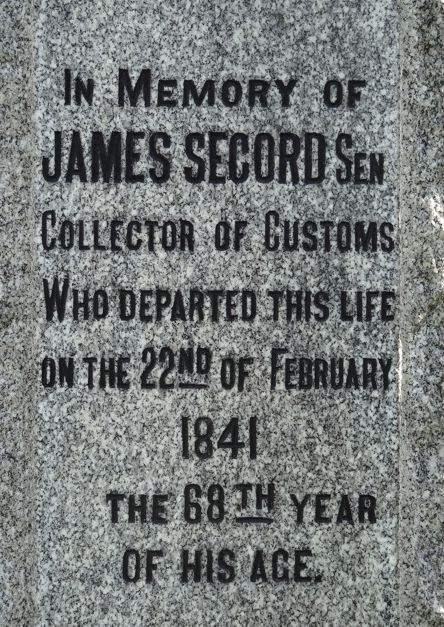
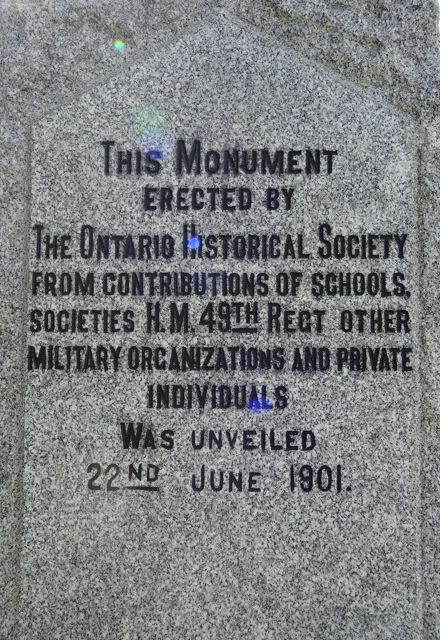
grave post - Laura Secord

This unassuming farm house in the (now very sleepy) town of Queenston is where Laura and James Secord lived from 1803-35 and where she raised her seven children (one son and six daughters). During the War of 1812, the home was taken over by the Americans who had added to her household demands by billeting three soldiers with the family. 


The American soldiers let down their guard and discussed a planned attack. James had been seriously injured during the Battle of Queenston Heights early on in the war and Laura was still nursing him back to health. I'm sure those soldiers never expected Laura to make her way through 20 miles of rough and dangerous woods to warn the British of their plan. But she did. Her heroic deed was not recognized until 1860 when the Prince of Wales made a visit and learned of her feat. Thereafter she became the celebrated heroine of many tales, poems, drama and legends. There was story about a cow being dragged along on the journey but that has been discounted as completely impractical. After the war, the comfortably well off Secords were reduced to poverty for several years. James eventually got a position as a registrar, then judge in Niagara and finally as a customs inspector in Chippawa. Since that was about 11 mi, or 18 km, away, they sold their house and moved. After he died in 1841, Laura was again left destitute and opened her cottage as a school for the Chippawa Natives to make ends meet.


There were no portraits of Laura, so we really don't know what she looked like, but there are two busts of her - one at Lundy's Lane in Niagara Falls and another in Ottawa near the NationalWar Memorial. Both James and Laura are buried at Drummond Hill Cemetery.

You can read all about her life here at Upper Canada History and also here
CemeterySunday and TaphophileTragics

Saturday, September 7, 2013

a worthy find

After going to the market in Ancaster on Wednesday, I drove around for a bit and found a lovely little church and graveyard where, of course, I had to stop...
and look who I found! more Norsworthys.
it isn't quite such an uncommon name as originally thought (Nicola), at least not in Devon England
This final resting place is about 80km away from the other Norsworthys in Ingersoll. it seems this family, although also emigrated from Devon, were not related to the John Counter Norsworthy family.

I found out later that Robert and Rebecca owned a farm at what is now the Knollwood Golf and Country Club. Had I known that I would taken a few photos there, too (because these posts about other people's genealogy is becoming my life).
an Anne Brooks in new Brunswick has contributed a lot of information on this family which I thoroughly enjoyed reading.
I have tried, half-heartedly, to look into my family's past but haven't gotten very far. There was a stage when I was very interested and frustrated by my father who kept changing his stories. My mother wasn't all that interested in her ancestry so that didn't help, either. But I have recently been contacted by someone who is distantly related and is working on a family tree. Interestingly, for the little I do know, I was able to help her right off by knowing that my grandmother died the day my brother was born. Who knows, maybe one day I will find a gravestone with my family name on it.

Tuesday, May 28, 2013

a garden

I needed to take my car for a long drive (for reasons you don't really need to know, but it seems the lights don't turn themselves off automatically on this car as they did with my other car, so...)
anyway, after watching the rain fall on the lake for long enough, I decided to drive around a cemetery for awhile. Doesn't everything look so green now that it has rained?
This lovely garden drew me to a closer look.
I didn't actually find the headstone, though there was a bench nearby, which seems to be from the family.

This poem by the garden touched me immensely
(sorry for the rainy blurriness)
sharing with taphophile tragics

Monday, May 20, 2013

grave post - Endean

A set of family gravestones from the Richmond Hill Presbyterian Church Cemetery. Harry and Edith were married in 1926. Harry and a brother started a nursery business sometime around 1910-20 around the same time as horticulture was becoming the main source of industry in the village. His son, Frank was a town councillor for three years, from 1988-91. The centre stone is for Catharine who passed away at two days in June of 1967. The similarities in the stones - including the flourishing writing style - suggest they were carved around the same time. 

Note the roses on the stones for Harry, Frank and baby Catharine.
Roses became a distinct part of the town's heritage due in large part to the influence of the flowers grown in the area. Even becoming  the town's motto "En la Rose Je Fleuris," which freely translates as "Like the Rose I Bloom," "I Bloom as the Rose," or "In the Rose, I Flourish."
mosaic at the Rose Garden

Tuesday, May 14, 2013

grave post - Abner Miles


When Abner Miles, an innkeeper and merchant from York, settled on the lots each side of (what is now) Yonge Street at Major Mackenzie Drive in 1801, there was not much in the village of Richmond Hill, so he began by establishing an inn, a store, and an ashery (a potash business, burning scrub brush and wood to produce raw ingredients for soap, candles and other mainstays of pioneer homes). The inn, or tavern, was perhaps the most important of Abner Miles businesses to help form the new community as it quickly became a favourite watering hole as well as a focal point for auctions, dances, masonic dinners and town meetings.
Soon, local residents and Yonge Street travellers were using the name Miles' Hill to refer to both the rise of land and the new community that gradually took shape along the road from Major Mackenzie Drive north through the core of modern Richmond Hill. Although Abner may have been the first resident of the area, it was the Miles' children who confirmed Abner's status as the "father" of Richmond Hill. The marriages of his daughters Hannah to James Playter, Lucy to John Langstaff, and Elizabeth to John Arnold marked the founding of three families who were to play important roles in the community's subsequent history. His son, James continued in his father's enterprises.
On his death in 1806, his son James inherited his land, what had by then amounted to two thousand acres, eventually donating land for the Presbyterian Church a manse, a school and a cemetery where his father was buried. 

Nothing is known of his education or early work. He was born about 1752 somewhere in Massachusetts. At some point he married a woman named Mercy, and together they had six children - five daughters, Hannah, Lucy, Elizabeth, Sarah, and Mary as well as son James.

I don't know where all the other taphophiles went, but now that the weather is nicer (sortof - we actually had bits of snow fall out of the sky yesterday!!) I have resumed my visits to cemeteries. I'll try to entertain you with my researches. There are more photos of the cemetery over on SightLines


Taphophile Tragics

Wednesday, October 31, 2012

grave post - pardes shalom

Another thing I noticed about this particular Jewish cemetery (admittedly, the only one I have spent any time in) were the personal tributes on the markers. I don't know if it is because this is a 20th century cemetery (it was created in the 1970s) and maybe this is a modern reflection, but I found it very touching to read these remembrances. They seemed to be a celebration of a life lived rather than the Victorian desperation of a reward in heaven.
above we have the traditional menorah for the woman and the Star of David for the man along with their relationships within their family - many listed as 'wife' 'mother', 'bubby' (in all its variant spellings) or 'grandmother' on down to aunt or sister etc.

but the personal memories were the most touching -                   "he sang whenever he had a chance"
I am sorry this one does not show up clearly (though it is more readable in in the photo editing site for some reason. click to embiggen)

"a man who believed in the beauty and power of music to create a world where people can live in peace, harmony and with justice and dignity for all"

"a woman who devoted her life to her community"


as we arrive at the time of year when many cultures are remembering and honouring their dead,
I would like to think that I would be remembered more for my life than my death.

see more honouring of the dead at Taphophile Tragics

Tuesday, October 23, 2012

grave post - Pardes Shalom

Last week, Halcyon and I went for a walk around the Pardes Shalom, a Jewish cemetery in the town of Maple just north of Toronto. It turned out to be much bigger than I expected, and in spite of the orderly rows, much more confusing to our uninitiated eyes to find our way around.
And, in looking up the history, I discovered that we missed a free walking tour! If only I had done the research as soon as I got home... though it is a long drive to go back.
Two things I noticed immediately that is different from many of the cemeteries I have wandered through recently is the neat rows with each grave facing the same direction and with the back of each stone including the surname. Maybe the names is not traditional but simply an accommodation to the fact that the entrance to this cemetery is at the western edge of the land, but it is a very nice feature. Also, the stones are pretty much all the same height with minor variations in the shapes - no one towers over the others or shows off with a large monument.

The Pardes Shalom Cemetery has been beautifully landscaped, which took five years, from 1972-77, to transform this former Christmas tree farm and gravel pit. Special attention was made to create a space that was as much for the living as for the dead. Had I gone on the walking tour I would now be able to tell you about the various species of the thousands of trees that were planted and the history of the land with the "attempts that have been made to promote the land's environmental health and the visual integrity of the cemetery".

What I can tell you is that there are 15,000 burials with most of the grounds filled with graves. Some of the plots once belonged to synagogues or burial societies while others were purchased directly from the cemetery. There was a variety of traditional and more modern graves, some were written on the front entirely in Hebrew, some had flowers, some had mementoes left. Almost all had stones left on top by those visitors who stopped by to remember them.


See more grave practices at Taphophile Tragics