Showing posts with label small town Ontario. Show all posts

Sunday, September 24, 2017

The Fishing Islands

On the shores of Lake Huron, part of the South Bruce Peninsula
The mainland of the Peninsula opposite the Islands is mostly low lying and sandy,forming in several places small sand-dunes. 

The area between the shore and the Islands has been filled in with sand, leaving large areas of shallow water, miles in extent, over which people may walk or     drive. At low water great stretches of sand show their rippled, yellow surfaces; and some of the islands become attached to the mainland or to each other. 
So it is, that a definition of an island at Oliphant is “a piece of land with    sand all around it.” 

The Islands in all number over seventy and vary in size from a mere shoal of     flat rock with a few currant bushes growing thereon, to the largest, Cranberry,       containing one hundred and twenty-four acres.
Just north of Hawksnest Island, a picturesque spot, at times a part of the       mainland and at times an island, the “Diagonal Road” from Wiarton enters by way  of Marie Street. The town-plot of Oliphant, laid out at the time of the Rankin      Survey in 1855, reaches from this street northward one mile. Here it was expected that a commercial centre would have sprung up, a hope which has never been real- ized and which has doubtless long since passed away. Point au Rock is a small    peninsula stretching outward from the centre of the town-plot. Westward from it  is a marshy formation of reeds, through which the far-famed Gut Channel passes,  forming the  key of inside navigation between the North and South. The name is   far from being attractive, but it is time-honoured, and will doubtless remain    for all time.
In the few years of Oliphant’s existence as a summering place, it has grown up   rapidly. Pretty little summer houses have been erected here and there along the  shore and islands, some hidden amongst the ever-greens, 
others out in the open sunshine, some on the well protected islands, and others away out where the
great storms of Lake Huron break and almost tear away their moorings. In all there are more than a hundred and fifty camps scattered over the region, and there is scarcely a town in Western Ontario that is not represented in their population.
We may sum up Oliphant’s     varied charms in just a      few  words. It is a place         romantic, historic, and      beautiful; it has many       islands, channels, and by-   ways to explore amongst; it  has some of the finest bass  fishing in the Great Lakes;   it has bathing that for      warmth of temperature can    scarcely be equalled; it     has splendid boating —       sailing, rowing, paddling,   and motor-boating; 
it has an annual Regatta where strength and skill of body and craft are displayed to advantage; it has three athletic grounds, one on mainland, one on Rabbit      Island, and one on Frog Island, the scenes of many ball games and field sports;  it has a church, a government dock now lighted, a spring that never runs dry, and may we add, a post office which brings, let us trust, many joys; it has never had a fatality or serious accident, to mar its sense of pleasure; and above all its  inhabitants are of a high standard of citizenship, from which emanates a spirit  of helpfulness and sociability so necessary in the life of people seeking health, comfort, and happiness. 
The first gathering of the campers was in the form of a picnic held in 1903 at Cranberry, the home of Mr. and Mrs. Cross. The next year it was held at Hawksnest Island. In 1907 the picnic was changed to a regatta and held at the Government Dock built the year before. The Regatta has proved an extremely popular annual event in which aquatic sports are keenly contested by all classes of campers old and young.

OLIPHANT AND ITS ISLANDS • LAKE HURON 

HISTORICAL AND DESCRIPTIVE SKETCHES 

WRITTEN BY IRENE MONKMAN AND ROY FLEMING 

COPYRIGHT, 1912 
A walk around the Oliphant Government Dock and Marina for Restless Jo
accompanied by a 1912 description of the area

Monday, September 18, 2017

following the PE&NS RR


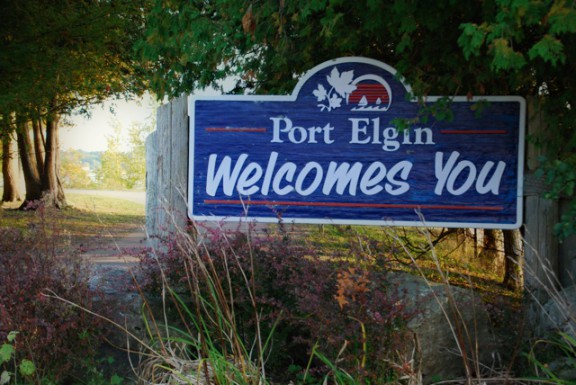
At this time of year (after Labour Day) the beach at Port Elgin is very quiet. 
Kids are back in school and most of the tourists have gone.
Even Lake Huron was quiet and calm.


the gazebo where weekly summer concerts are held is a perfect place to sit and read out of the sun if you have a lawn chair with you, which you will also need for those Sunday evening concerts.


the little steam train sits quietly waiting for the weekend when it will run through a 1.6km trip on the Port Elgin and North Shore Railroad around the harbour and park, blowing its whistle along the way. I can hear it from the cottage where I am staying. it has been running for decades, and there are plans to have the station renovated and upgraded, and possibly moved to the North Shore Park at the other end of the waterfront, which led to false rumours that the town might scrap the train altogether.
in the background you can see the newly built Edinburgh Club, the first luxury condominium to be built on the waterfront. there are still 2 units left, according to a sign on the other side.


only three of the boats at the marina have been dry docked that I could see. and, glancing at the petrol pumps, I noticed the price is .20 cents more expensive than for autos (at $1.38 litre)


some Canada Geese were lazily drifting in between the boat docks, 
with others heading in to join them
until something spooked them 
(wasn't me, I'm sure!) and they suddenly all took off
there is an open area between the harbour and the park where this majestic willow takes pride of place. see how I cleverly included the house with my favourite upstairs sunporch? just for scale, of course.
the train tracks are that line in front of the willow
further down, a walking trail takes you through the North Shore Park where you will cross the narrow gauge of the railway near where it turns around
and, finally, another resting spot to view the sunset. 
the water is still at a high level.
from there, the trail continues on ...
(that is Chantry Island Lighthouse in the distance)
sharing with Jo's Monday Walk
and Our World Tuesday
the first pictures were taken in the early morning, the last seven in the late evening

Tuesday, August 8, 2017

village bell

From this site, the rich vibrant tone of this bell could be heard throughout the village
For over fifty years, beginning in 1890, the village bell announced the out break of fire. When the First Pickering Fire Company of volunteer firemen was formed in 1889, money was collected from the villagers by subscription to ensure fire protection.
A 200lb bell was ordered but was returned for a 500lb bell when concerns were raised that it might not be heard everywhere. Whenever fire was discovered in the village, the first person to reach the fire hall would ring the bell to call volunteers.
The bell also rang four times a day at 7, 12, 1 and 6 by a paid bell ringer to announce the beginning of the work day, lunch time, end of lunch hour and end of work day. On Sundays the bell called villagers to worship at various churches. On V.E. day, the bell rang continuously to announce the end of the war.

for Tuesday's Treasures

Monday, July 24, 2017

rubber ducky

Went for a day trip to Midland last week

(not on the day thousands were trapped on the highway when it was closed for 11 hours due to an accident, thank god!)   (photo courtesy of cp24 news)
The harbour has changed a lot since the days in the early 1900s of this postcard
it's on the southern tip of Georgian Bay
but what we were looking for was this
at the foot of King and First Streets

The giant rubber ducky that has garnered so many complaints from those who have no desire for fun and silliness in their lives. This was her first visit to Canada and she made her appearance for the Canada 150 celebrations.  (just google rubber duck toronto and scroll past the newer stories of how spectacularly successful it was to the weeks before she arrived and read all the whining about the cost, what a duck has to do with Canada's sesquicentennial, the cost! ... ad nauseum)
She is big. Six storeys tall. It takes almost 3 hours to inflate.
And it was a LOT less crowded here than in Toronto (hence the 3 hour drive)
Keeping the duck company is this swan sculpture
which celebrates the efforts of those who helped reintroduce the trumpeter swans to Georgian Bay. The swan sculpture is more life size.
We didn't see any swans, though
just a big duck who couldn't hide no matter how hard she tried
Then, we walked round town looking for murals, but that will be another post. I'm reintroducing myself to short walks for Jo's Monday walk

Monday, August 22, 2016

carvings

While wandering around Wiarton one quiet evening, I noticed some interesting creatures lurking. Wiarton is home to the albino prognosticating groundhog which I previously wrote about here. He is everywhere in town, but now he has some friends (at least I hope they are friends, or it could get nasty with wood chips flying...)
footprints along the sidewalk
and then a few more creatures...
there were no doubt a few more to find, but it was very warm out and I had an ice cream in one hand and a camera in the other...
then down the road aways, just south of town, was the source
Edwards Outpost has tree sculptures, carvings, a gallery, antiques, wool, and a chip shop if you get peckish run by Bobbi Switzer and Edward Knopf. But none of that was open at the time.

 
These tree sculptures were made by Bobbi Switzer. When a tree needs to be cut down due to rot, or other damage, often the stump is perfect for a transformation. She has done several carvings in the area over the last ten years or so, (another example is here) and now even her daughter has taken up the chainsaw.

a little something different for Jo's Monday Walks
and some signs for Lesley's signs, signs