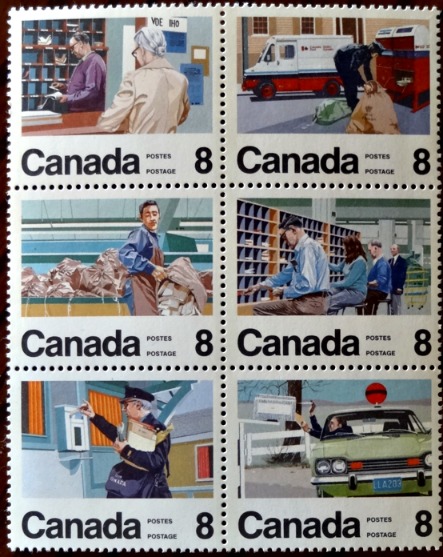
Celebrating the 100th anniversary of
Sunday Stamps, I chose this most appropriate 100th Anniversary of the letter carrier delivery service in Canada.
This set was designed by Stephen Mennie in 1974 to honour all the busy postal workers of Canada Post. First up is the Postmaster, then the mail courier, mail handler, mail clerk, letter carrier, and the rural mail courier.
Of course letter delivery was going on long before 1874,
here is [an edited] blurb provided by the website
Canada's first "postmen" - unofficial of course - were the Indian runners who carried messages between neighbouring tribes using wampum beads. The official runner of the Iroquois tribe, for example, carried a string of white wampum beads if the message was of peace, prosperity or goodwill, and blue beads for war, disaster or death. During the days of the fur trade, voyageurs, coureurs de bois and Indian couriers carried mail and messages to the few fur factors, government officials and missionaries in outlying areas. The first official letter carrier in Canada, appointed in 1705, was a Portuguese Canadian, Pedro da Silva, commissioned to carry the Governor's despatches between Québec, Trois-Rivières and Montréal. Da Silva bolstered his salary by carrying private letters at a fee which he based on the distance travelled; he charged ten cents to convey a letter from Québec to Montréal. Before a postal system was available, anyone in New France who wished to send mail to Europe arranged with friends in Québec to take their letters to the captain of an outgoing ship. Friends would also pick up incoming letters and arrange for their delivery by da Silva or some other hired person. In 1851, the provinces took over from the United Kingdom full responsibility for administering the postal service. In that same year, the first Canadian stamps for prepayment of postage were issued. These included the famous red "three penny beaver" designed by Sir Sandford Fleming. With Confederation in 1867 the Canada Post Office was formed and took over the responsibilities of the provinces in postal matters. Uniform postal rates were established and the practice of prepayment of mail was enforced with fines being charged for mail that was not prepaid. At that time, letter carrier delivery service was available in certain large cities. For this service, however, in addition to the postage paid by the sender, the recipient had to pay to the letter carrier upon delivery a charge of two cents on each letter and one cent on each newspaper. In 1874, free letter carrier delivery service was introduced by the Canada Post Office in Montréal and in Toronto, Québec, Ottawa and Hamilton the following year.
My father was a mail carrier for many years and this was his set that we found amongst his things after he died.